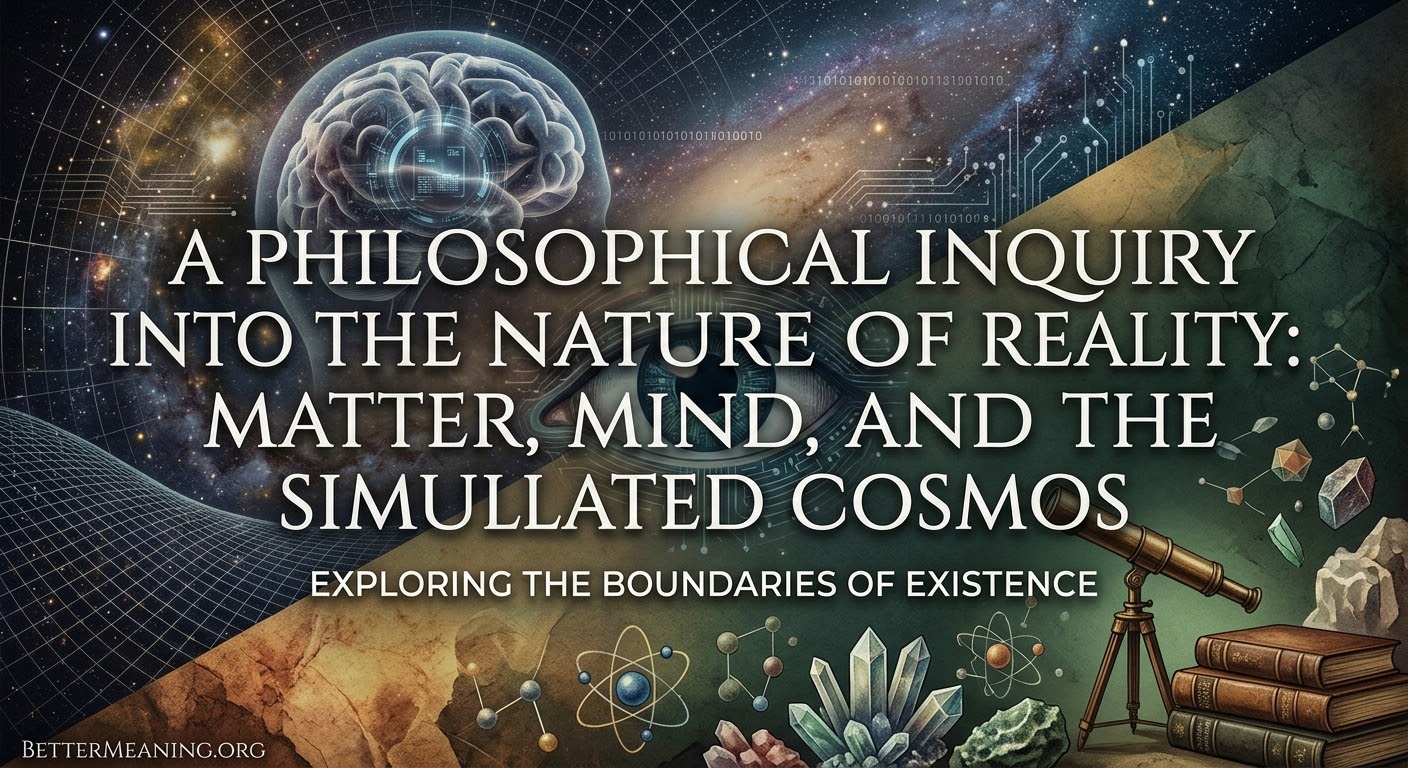
I. Introduction: Unveiling the Fabric of Existence
Humanity’s enduring quest to understand the fundamental nature of reality has given rise to profound philosophical debates. The seemingly straightforward distinction between “what is real” and “what is perceived” becomes complex when interrogated through the lenses of matter, mind, and the possibility of simulation. This report delves into these foundational inquiries, exploring how sensory experiences and information processing capabilities shape, and potentially limit, the understanding of existence.
This report systematically examines the historical development, core tenets, key proponents, and contemporary relevance of Materialism, Idealism, and Dualism as competing metaphysical frameworks. It then transitions to a modern challenge to the understanding of reality: the Simulation Hypothesis, a probabilistic argument suggesting that the universe might be an advanced computer simulation. Underlying all these debates is the critical role of human perception and information processing — how sensory data is gathered, interpreted, and understood is integral to how individual and collective realities are constructed.
II. The Foundations of Reality: Materialism, Idealism, and Dualism
A. Materialism: The Primacy of Matter
Materialism is a form of philosophical monism, asserting that matter is the fundamental substance of nature. According to this perspective, all phenomena, including mental states and consciousness, are understood as results of material interactions. This stance posits that everything that exists is physical, and modern materialism is often considered synonymous with “physicalism.”
The historical trajectory of materialism traces its roots back to classical antiquity with atomists like Leucippus, Democritus, and Epicurus, who explained change as collisions of indivisible atoms. Ancient Indian philosophy also saw the development of materialism around 600 BC. In Western philosophy, materialism gained prominence in the 16th and 17th centuries with figures like Francis Bacon, Pierre Gassendi, and John Locke. The 19th century witnessed the development of “historical materialism” by Karl Marx and Friedrich Engels.
Within the materialist framework, various interpretations exist — from Atomistic and Mechanical Materialism to the more radical Eliminative Materialism, which claims that the common-sense understanding of the mind is deeply flawed and that some posited mental states may not actually exist.
Despite its strong scientific alignment, materialism faces significant challenges. The most prominent is the “Hard Problem” of Consciousness, which questions how physical processes in the brain give rise to subjective, qualitative conscious experiences. The Knowledge Argument, famously articulated by Frank Jackson with his “Mary” thought experiment, posits that a super-scientist knowing all physical facts about color vision would still learn something new upon experiencing it — suggesting that physical truth is not the whole truth.
B. Idealism: Reality as Mind or Spirit
Idealism asserts that, at its most fundamental level, reality is equivalent to mind, spirit, or ideas. This philosophical stance emphasizes the mental or spiritual components of experience and often renounces the notion of material existence.
Plato, a prominent early exponent, believed that the physical world is not truly real but a constantly changing shadow, while the true reality resides in a world of unchanging and absolute ideas or Forms. George Berkeley further developed subjective idealism by arguing that reality is purely a product of perception, famously asserting “esse est percipi” (to be is to be perceived). Immanuel Kant revolutionized idealism with his “transcendental idealism,” arguing that the human mind actively shapes our understanding of reality by imposing inherent categories and structures on experience.
Idealism maintains enduring relevance in addressing skeptical hypotheses. By positing that reality is appearance, idealism can dissolve certain skeptical worries — and serves as a historical precursor to the Simulation Hypothesis, where perceived reality is an internal construct, albeit a digital one.
C. Dualism: The Distinct Realms of Mind and Body
Dualism is the theory that the mental and the physical — mind and body — are radically different kinds of things. This perspective posits that mental phenomena are non-physical, or that the mind and body are distinct and separable entities.
René Descartes popularized dualist thought in the 17th century, asserting that the mind and body have fundamentally different properties: matter is spatially extended, while mind is unextended and thinks. His famous declaration “I think, therefore I am” laid the groundwork for understanding the thinking subject as the primary certainty.
Dualism faces its most prominent challenge in the Interaction Problem: if the mind is a non-physical substance, how does it interact with the physical body? The Causal Closure of the Physical is another major objection — if every physical event has a physical cause, there is no room for non-physical mental causes to influence the physical world without violating physical laws.
Despite these challenges, dualism remains compelling because it validates the felt reality of our inner lives in a way that pure physicalism sometimes struggles to articulate, suggesting that philosophical inquiry into consciousness extends beyond mere factual description to encompass the very conceptualization of our being.
III. The Simulation Hypothesis: A Modern Challenge to Reality
A. The Core Proposal and its Philosophical Roots
The simulation hypothesis proposes that what one experiences as the real world is actually a simulated reality — a computer simulation in which humans are constructs. This concept has deep philosophical roots that predate contemporary computing. Plato’s “Allegory of the Cave,” Descartes’ “evil demon” thought experiment, Zhuangzi’s “Butterfly Dream,” and the Indian philosophy of Maya all serve as historical precursors. The simulation hypothesis can be viewed as a modern reincarnation of these ancient skeptical and idealist arguments, re-framed using contemporary computational terms.
B. Bostrom’s Simulation Argument: The Trilemma
In 2003, philosopher Nick Bostrom formally proposed the simulation argument, presenting a “trilemma” — asserting that at least one of the following three propositions must be true:
- The human species is very likely to go extinct before reaching a “posthuman” stage — civilizations capable of running simulations rarely arise.
- Any posthuman civilization is extremely unlikely to run a significant number of ancestor-simulations — advanced civilizations choose not to, perhaps due to ethical restrictions or lack of interest.
- We are almost certainly living in a computer simulation — if advanced civilizations do create many simulations, the number of simulated beings would vastly exceed those in base reality, making it statistically probable that we exist within a simulation.
C. Arguments Supporting the Hypothesis
Several lines of reasoning lend support to the simulation hypothesis. Computationalism posits that cognition is a form of computation, establishing the theoretical possibility of artificial consciousness within a simulation. Rapid advancements in AI and VR suggest that creating high-fidelity simulations is increasingly plausible. Some physics theories point to the discrete nature of reality at its most fundamental levels — such as the Planck length and quantum mechanics — as evidence consistent with a computational universe, akin to pixels in a digital display.
D. Criticisms and Counterarguments
The hypothesis faces substantial criticisms. A major concern is its unfalsifiability — there is no conceivable empirical evidence that could definitively prove it wrong, rendering it unscientific in the traditional sense. Critics also question the computational feasibility of simulating every atom, electron, and photon in a universe. Bostrom’s probabilistic assumptions — particularly the idea that humans are “typical” conscious beings — are also challenged. Finally, profound ethical and existential questions arise: if humanity is simulated, what does this mean for free will, purpose, and the moral obligations of the creators?
IV. Perception, Consciousness, and the Construction of Reality
A. Sensory Perception: Our Gateway to Reality
Sensory perception serves as humanity’s primary interface with reality. A crucial distinction exists between sensation — when sensory receptors detect stimuli from the environment — and perception — the psychological process where raw sensory information is organized, interpreted, and consciously experienced. Each individual perceives the world through a unique lens, colored by emotions, beliefs, past encounters, and cultural backgrounds.
Central to this discussion is the concept of qualia — instances of subjective, conscious experience, such as the perceived sensation of pain, the taste of wine, or the redness of an evening sky. They represent the “what it’s like” aspect of experience and remain central to arguments against physicalism, as critics contend that no amount of purely physical information can fully capture these subjective features.
B. Information Processing and the Mind-Body Problem
Computational neuroscience provides powerful tools to explore how subjective experience arises from neural activity. Prominent models include Integrated Information Theory (IIT), which posits that consciousness arises from the integrated information generated by causal interactions within a system; Global Workspace Theory (GWT), which suggests consciousness involves a “global workspace” where information from various systems is integrated; and Neural Darwinism, which views consciousness as an emergent property of neural networks shaped by experience.
The AI consciousness debate pushes these boundaries further, distinguishing between the “Hard Problem” — why subjective experiences exist at all — and the “Soft Problem” — what it means for AI to exhibit consciousness-like states that arise and dissolve dynamically. Some theories suggest that even human conscious experience may be discontinuous, stitched together from rapid bursts of neural processing, implying that AI’s transient awareness might be closer to human consciousness than commonly assumed.
C. Virtual Reality and the Redefinition of Experience
Virtual Reality (VR) technology significantly impacts the understanding of perception and reality by creating simulated environments so convincing they can alter the perception of what is real. VR has demonstrated significant value in neuroscience, cognitive rehabilitation, and exposure therapy. Higher immersion in VR environments is associated with a stronger sense of presence and more pronounced emotional reactions.
VR also introduces new complexities for personal identity and ethics. It becomes challenging to distinguish between avatars controlled by real humans and virtual agents controlled by AI, raising profound questions about identity, truth, and the nature of experience in virtual spaces.
V. Conclusions: Synthesizing Reality’s Complex Tapestry
The philosophical inquiry into the nature of reality, spanning from ancient metaphysical debates to contemporary technological challenges, reveals a complex and interconnected tapestry of understanding. Materialism, strengthened by scientific advancements, posits a fundamentally physical reality yet grapples with the “hard problem” of subjective consciousness. Idealism elevates mind or spirit as primary, offering unique resolutions to skeptical doubts. Dualism attempts to reconcile both, asserting distinct mental and physical realms, but struggles with the fundamental problem of interaction between them.
The Simulation Hypothesis re-frames ancient skeptical arguments in a technological context, compelling a re-evaluation of humanity’s future and the probabilistic nature of its current existence. Meanwhile, sensory perception and information processing are not merely passive conduits but active constructors of perceived reality.
The ongoing discourse across these philosophical and scientific domains demonstrates that the quest to understand reality is a dynamic, interdisciplinary endeavor. Each perspective — whether ancient or modern — contributes to a more nuanced appreciation of existence, consciousness, and the intricate ways in which sensory and informational stimuli shape the very fabric of what is considered real. The answers remain elusive, but the inquiry itself continues to expand the horizons of human understanding.
You must be logged in to post a comment.